Goblina and the Magic Ribbon campaign notes: Work in Progress!
Information about the Plane, Continents, and Culture
Plane Name: Ayarean
Theora (land of the winged) > capital Aggepolis > People referred to as “Theoran”
Allasos (forest in mists) > no one knows, the entire country is shrouded in mystery, including the true nature of the people there > People referred to as “Allasoan.”
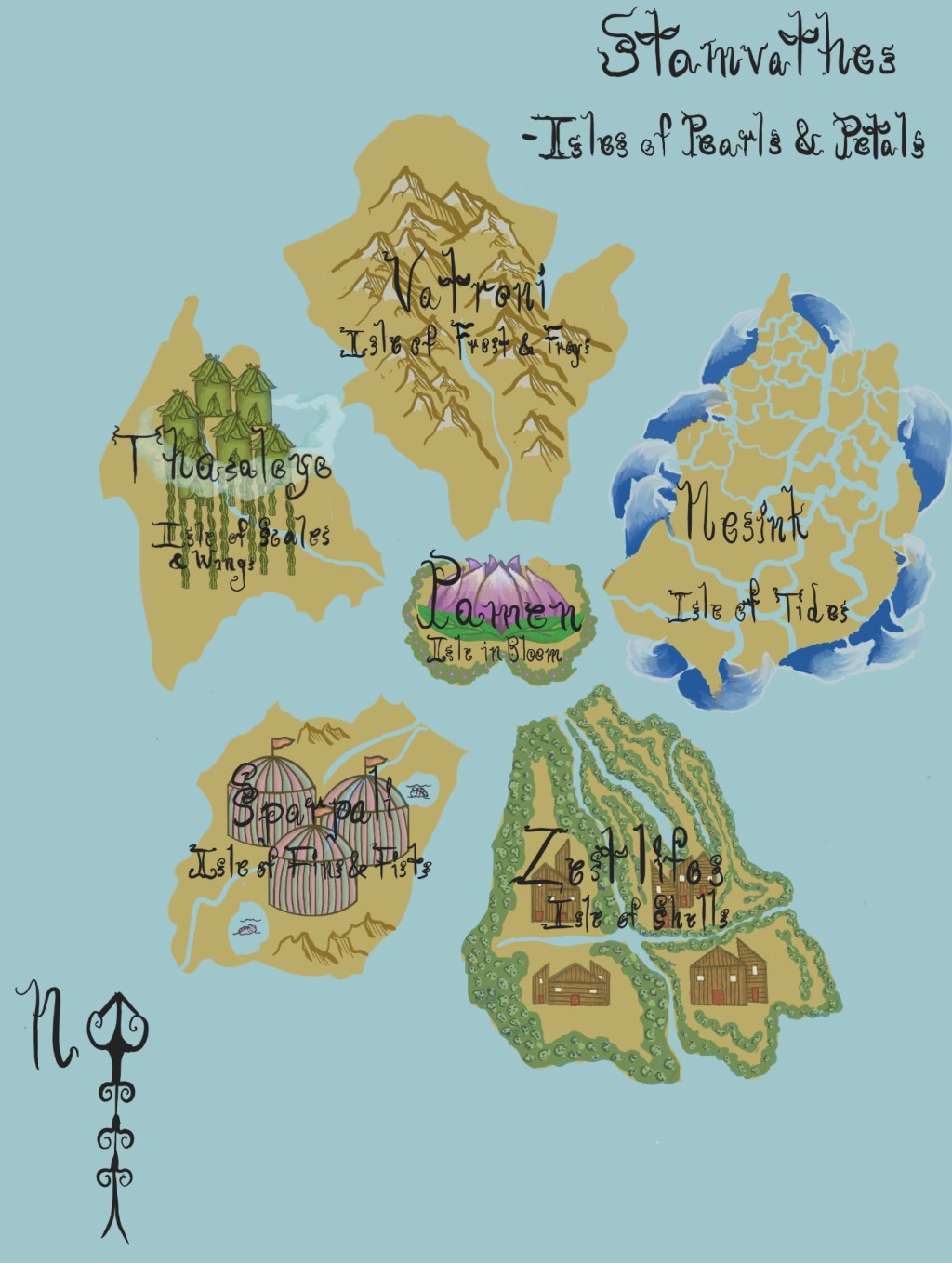
Stamvathes (country of blooms and pearls) > Pamen (capital > Stamis) > People referred to as “Stamvathes.”
Cultural Notes of Stamvathes
Lack of gender/clear gender roles, general use of they/them or names.
Lack of strict relationship structures (many live in communities where copulation between is acceptable and normal but others choose to have fewer partners or no partner) > big culture of ‘doing your part,’ to be involved in society. Children are shared between kin as all Stamvathes believe they are family by blood, even if its to a small extent. No last names due to the mindset of singular family, or lack of care about family. Some choose to have a last name, but this is uncommon).
Goblins each perform a function, some choose singular path, others move from commune to commune performing different jobs (a la the dispossessed) and this helps to build the notion that all Stamvathes are interrelated, breaks down notion of inherent family structure, opting for chosen families.
Call themselves Stamvathes rather than by species.
Pamen
Pamen is in charge of governance, resource allocation, scientific development, and artistic development. The colony is protected by a large bloom that is magically controlled by the elite guard of Pamen, the Loutriotis, which allows it to open and close. The entire country is covered in flowers, said to be blessed by the original magic of Gepniv that gave magic to all of Stamvathes. As a result of this natural protection, the colony is in charge of governance and resource allocation as it is the safest spot in al of Stamvathes. Pamen’s architecture is primarily plant based: shaped through magic to mimic traditional building materials. The homes are generally simple, square or rectangular, with elaborate relief on the outer doors. whereas the architecture for the rest of the city is generally made up of columns and open doors.
Vatroni
Vatroni: cold, mountain dwelling goblins. Main city: Krikreas. They help to produce certain vegetation and raise the Testav as they can. Their meat is good and the people know how to deal with cleaning the meat. The people are outgoing and happy to have visitors, usually not seeing anyone, as many Stamvathes do not want to travel to Vatroni. The community is small as a result, but the Stamvathes in Vatroni are always happy to have people come in.
Nesink
The islands here are barren, frequently being covered by water entirely. No main city. Underwater there is a colony of Stamvathes. Nesink is the smallest colony in all of Stamvathes, existing almost entirely underwater. The community is secretive, not particularly happy to have visitors as they consider themselves generally outside of society, which is where almost all of the outsiders of Stamvathes choose to go. They are in charge of the nation’s eastern defense, able to surprise invaders due to the hidden land of Nesink. The community embraces individuality over the collective. They understand that they have a duty (although their understanding of it is less attached to the other colonies, realizing that their own self-interest is inherently tied to the country’s defense) but generally prefer to be in smaller family units, monogamous, but happy.
Zestlifos
Farming community in a tropical setting. Main city: Karmouro. Large amount of cities, generally following the same theme of the rest of Stamvathes, polyamorous, sharing the load of labour. The colony is in charge of cultivating the Goberry, a plant that grows in a sturdy shell that is highly nutritious and only grows in hot, humid climates. The plant is highly nutritious, but hard to cultivate due to its sensitivity to almost everything. The community is harder working than most, warm and welcoming. They survive mostly on Goberries with little meat from the other colonies (which is generally not as fresh because it needs to be shipped). They fish a little, but it can be hard to make time for it.
Sparpali
A colony in charge of training the soldiers of Stamvathes. No main city due to nomadic nature. The buildings are generally makeshift, moving as need be. There are natural resources here, but a lot of the food comes from the other colonies. Sparpali is a temporary community, most Stamvathes choosing to live permanently in Zestlifos, Pamen, or Thasaloyo. Sparpali, although not a violent colony, loves to fight and hold contests regarding their own strength. As a result, the community regularly holds competitions to display feats of strength, courage, and other physical prowess. There are few children here, and, generally when children are born, they are sent somewhere better able to accommodate them.
Thasaloyo
Singular colony, divided into east, west, north, and south. City is mainly in the sky due to the barren nature of the land below. Having learned the cloud crafting magic of the Theoran, the Stamvathes have created cities by combining the magic of Pamen and Theora into a skyborne city. This is particularly necessary as the main function of this city is to raise the Ippogrif and the Drakbundant, amphibious animals that can also fly if needed. The raising of these animals allows the harvesting of the clouds to be more efficient, allowing the city to expand and send cloud material the rest of Stamvathes. The material is used to create weapons, clothing, and can even be eaten. Happy, but hesitant of visitors as the animals do not take as kindly to new people.
Campaign beginning info

Patron’s Vessel: Loufithi Decoration
In my iteration of the campaign, I have asked all of the players to create characters and backstories that are not from this plane. By asking players to do so, we put them into a situation of genuine discovery: where both the player and character aren’t aware of this world and aren’t expected to act like the culture is ‘normal.’ This is to encourage discovery through game play as the player is easily able to empathize with the character’s discoveries, hopefully leading to further immersion and bleed. Additionally, by creating new backstories out of our control, the players can have a chance to interfere with our storytelling as we weave their world into this one. Tell your players the above information about Stamvathes, up until Pamen.
Party starts in a bar in Pamen called, “the Gelded Bell.” The bar is filled with little goblins, mostly dressed in informal wear: overalls made from cotton, cloaks, some with lab coats. The establishment has 8 foot high ceilings, meaning some of the players may feel cramped. The interior is filled with small bar tables, made up of vines and flowers, shaped and crystalized to support their own weight and much more.
Patron’s Vessel: Hands of Gepniv
The bartender is a particularly short goblin, with clams braided throughout their hair and moustache. The square-faced, curvy figure, can offer drinks. If the players aren’t doing much, maybe a goblin from the bar can interact with them, pointing out that they aren’t from around here. Eventually, the characters will hopefully get to know each other. Once this is done, a back door appears in the bar in a flash of pollen and petals. The door swings open and a larger (4′), muscular goblin points at the outsiders, saying their patron will see them now.
Patron is a masked figure (mask decorated with a snake eating its own tail), laid back in a velour lounging chair. A white, opaque tunic with gold floral embroidery and lace edges cover the goblin’s body. A high-waisted belt with an iridescent seashell clasp sits below their small breasts, cinching the figure at the waist. They sit behind a large table made up on vines, branches, and flowers, shaped through magic and finished with a thin veneer of glistening resin. The table is elaborately carved with imagery of seashells, clownfish, seahorses, and seadragons. On top of the table sits a large vessel, shaped like a flower. The vessel is elaborately decorated in relief work, inlayed with purple and orange stains. The figure a tall, slender goblin, in an opaque, white tunic with small breasts asks the players to come in. The figure won’t say their name unless convinced (persuasion roll, ~15 based on your discretion as DM and the player’s actual statement). They are called Aya, a wealthy bureaucrat turned philanthropist). Aya asks them if they want a drink. Aya tells them that Goblina, a goblin has magically appeared in their world. Despite appearing Stamvathes, it is clear that Goblina isn’t (unheard of accent, unaware of the world around her or its customs, not registered within Pamen’s citizen registry). Her appearance, at first pleasant and charming, has taken a turn as mischief follows Goblina wherever she goes. The different towns and continents have reported small nuisances such as turning dresses to pants, pants to dresses, altering the Stamvathes’ physical appearnance, but has potentially devolved into taking away the magic from Stamvathes altogether, making them ‘still,’ a term used to describe those without the ability to change their sex and appearance at will.
Aya wants the party to find Goblina and bring her back to them. Aya is worried that other Stamvathes organizations (Aya won’t divulge who, even when asked) will find out what is happening and they will hunt Goblina down by any means. If Aya is asked and persuaded, they explain to the players that body in charge of distributing additional aid wherever needed, the Root Syndicate, would likely take action on this soon and do whatever is needed to protect Stamvathes, including harm Goblina. As a result, Aya is concerned for Goblina’s safety as well as the possibility that, if put in peril, that whatever magic Goblina is capable of might damage the country further. The reward is 1000 gold pieces each as well as access to higher level magic that might be able to send them home if they wish. If they argue, Aya will try to accommodate them if possible (you’re the DM, I’m sure you can figure it out ;D).
Aya will tell them that they aren’t sure where Goblina is, as there are reports of mischief throughout the plane with the exception of Pamen, which is hard to get into without express permission. As an outsider known for causing trouble, Goblina would be unlikely to get in without them or the rest of Pamen knowing.
There are additional tasks to complete in Pamen:
5 different shops to go into:
Enchanter (blesses weapons): Enchanter (Nett) is a quiet goblin, large beard, flat chested, in an elegant gown embellished with pulsating floral embroidery. The enchanter asks the party to go to Nesink and retrieve a rare mineral called Spirnera. When turned into a dust, the mineral is able to coat weapons and armor transforming normal materials into magical ones. If you retrieve, the Enchanter will create magical weapons for you for the cost of the labour only
Blacksmith (weapons and armor): Blacksmith (Eepa) is a slight creature, undetermined appearance due to a large suit of equipment they refuse to take off for whatever reason. Eepa asks the adventurers to go to Sparpali and retrieve the scales of the warrior fish, Sparpsari. If they retrieve these scales, 1 large scale per equipment, the blacksmith will happily make them non-magical equipment that stays sharper.
Alchemist (potions/poisons): Eccentric creature (MeeMeep) in odd robes, similar to enchanters. Their hairy chest showing from a low cut top, covered with long hair draped across their shoulders. The alchemist asks the group to go to Zestlifos. MeeMeep wants the group to collect berries from the sacred trees located in the Zestlifan forests. These trees contain particularly large Goberry shells, keeping particularly ripe and potent berries. The berries, unlike regular Goberries, carry particularly high levels of a sugar, Proterone. The sugar makes particularly potent healing potions. If you bring them the berries, MeeMeep will make you potions at cost).
Church (Gepniv’s Temple): The church is busy, easily the biggest building in all of Pamen. Goblins walk, chat, and pray everywhere. Priests walk by, answering congregants with the exception of one who takes notice of you. This priest, with ratty robes waves to you erratically and starts running toward you. The priest, Jathew, rants and raves about the ‘visions,’ Gaiterogen has blessed them with, signalling impeding doom. The visions tell Jathew that the oceans will rise, covering all the land until there is nothing but clouds, killing everyone, even the Theoran. Jathew asks the party to go to Vatroni to retrieve the goo from the frozen frogs, Testav. The goo induces hallucinations in those who ingest it and allow Jathew clearer visions.
Artist (in charge of the art scene within Pamen): The art gallery is a small building, the art within spans a wide array of styles from functional ceramics to abstract performances played through the eyes of magical plants that allow projection. The curator, (Rugelo) a larger mustached goblin wearing a cape and top hat approaches the party, asking them if they like the art. Rugelo asks the party to travel to Thasaloyo and pick up some artwork from a friend of theirs, Darveer. The party is offered 1000 gold total for completing this task (Rugelo won’t tell them anything about the art, and nothing about Thasaloyo unless asked; but Thasaloyo is notoriously dangerous due to its chaotic weather patterns, vertical positioning, and the wild Ippogrant and Drakbundant, flying seahorse/sea dragon looking creatures that, when raised, can be perfectly peaceful, but otherwise tend to be territorial. The art is sculptures made of their scales, which will attract the creatures to the party which will try to kill them.)
Library: improved; they didn’t find much
Encounter (future): 3 needle 1 vine 1 twig blight (crabs, but use these stats).
Adventures in Nesink:
Music:
Pirate Ship: Pirate Sailing Music Copyright Free Music
Above water: Beach MBB
Above water mystery: Mystery – GoSoundtrack
Battle Music above water: Good day to Die [Epic] Miguel Johnson
Underwater: underwater Roa
Battle music underwater: underwater gh0stly
Nesink: The islands here are barren, frequently being covered by water entirely. No main city. Underwater there are several groups of Stamvathes. Nesink is the smallest colony in all of Stamvathes, existing almost entirely underwater in several small communes that are separated by large bubbled domes. The communities are secretive, sharing information only with each other and with the government in Pamen as a result of their highly important work (after all, they don’t want to give the Spinera to other countries as the mineral helps enchant their weapons to defend effectively if they need to). They are not particularly happy to have visitors as they consider themselves generally outside of society, which is where almost all of the outsiders of Stamvathes choose to go. They are in charge of the nation’s eastern defense, able to monitor or surprise invaders due to the hidden land of Nesink. The community embraces individuality over the collective, a result of many of the inhabitants coming to live here specifically to escape the collective identity of the Stamvathes. They understand that they have a duty (although their understanding of it is less attached to the other Isles, realizing that their own self-interest is inherently tied to the country’s defense) but generally prefer to be in smaller family units, some monogamous and others not. The communities are happy, help each other openly, and share, having more limited resources, particularly lately, as many of their resources are reallocated from Pamen. While not actively standing guard, they are also in charge of resource extraction, mining the Spinera for the country.
After combat, the party will board a ship. The ship is about 50’ long, 15’ wide and 100’ height. Iridescent shells, dark wood, and opalescent scales of the Ippogrif other materials create this smorgasbord of a ship. A leaping Sparspari, a fish that you might recognize as a clownfish with elongated fins and several pearls on its forehead and chin is mounted as the figurehead of the ship. A goblin greets you (ask for ticket). The party can investigate the ship, but there is no treasure on board. They only find large, lidded storage jars with several handles. Twine runs through the loop of the handle of the lid, tied to the handles on the side. They stand about 3-4’ tall leaning against a wall. As the ship moves, the jars lightly tap against each other. (Inside, the party would find berries and meat). The rest of the ship is relatively standard (crew quarters, captains quarters etc…) with nothing of intense interest. Light fixtures are made of ceramics made to look like a variety of objects (shells, fish, frogs, etc…) generally holding candles. The crew drink out of flattened, corked jugs, and eat off of simple dinnerware with frilled lips.
The party arrives on Nesink and sees only barren islands. If they ask, the other Stamvathes will likely describe Nesink’s above water structure and little about its underwater structure as the Stamvathes either usually don’t go to Nesink, and, if they do and leave, they know not to share too much information regarding its nature with anyone who doesn’t already know. Depending on how hard they try to find out information, or how high they roll, the characters will know more or less; if they roll well, they will be told the basics of Nesink (underwater Isle split into several smaller villages with a focus on mining and defense)). On each isle (big enough for about three people to stand on before they are separated by about 5 feet of water each), there is a rune that, when JUMPED on causes that particular islet to sink. If the group all figure it out, great, otherwise move on. The group can travel to individual isles if they want, they can even go away from Nesink, but trying to leave will trigger another combat (after which they are welcome to go to another isle). If they choose to stay, the other isles are shown to be essentially barren pieces of land, seaweed strewn about as well as other washed up aquatic life. Additionally, if they investigate, they will find marbled seashells that have the ‘breathe water,’ spell on them with the adjustment that the spell is permanent. The group should likely know that Nesink is underwater at this point so they can swim down and start a dungeon crawl situation, (Underdark style; survival check to find rations/determine speed (I assume down?)). Underwater, there are several aquatic animals including ippogrifs (seahorses with large, scaled wings, shell helmets, and pearls on their foreheads), Dragbundant (sea dragons with butterfly wings, iridescent scales, and pearls on their foreheads, and Sparspari to name the easily recognizable ones. There are also aquatic flora such as gigantic coral reefs, sea anemones, and seaweed forests that obscure the way. The travel should take about 10 hours of swimming, they roll a d6 with adv. If they succeed the survival check. An Athletics check determines whether the group can actually SWIM FOR 10 HOURS as this would be exhausting. Investigation checks show goblin hideouts within the wildlife. Events trigger every hour roll (d1-2 is nothing, d3-4 is combat, d5 is finding the remains of a Sparspari (can harvest its scales/pearls with a survival check, but if they take too long another combat will trigger as Sparspari tend to come retrieve bodies) and d6 is a Stamvathean encounter, who will ask them who they are, what they are doing, and will try to apprehend them. If the group doesn’t manage any of this, it triggers a tidal wave event. The group can investigate one more time (or passive perception if you see fit) but, if they fail, they will take 1d6 damage The group will be saved by goblins (Dex/athletics check) who are patrolling the area. If this happens, the group is taken captive as a result of having Theoran with them. If they manage to make it to Nesink by themselves, they come upon an opaque bubbled dome with a concave top. The bubble DOES NOT penetrate the sand, so theoretically, they could dig underneath the dome. From this vantage, a Stamvathe greets them and demands to know their business. The group will likely try to explain the Goblina problem. If they manage to remember that the vessel is a family heirloom and the symbol on the back (or are otherwise clever/convincing – let them see if they can come up with something), they are let in voluntarily, otherwise they are either let in with hesitance, or apprehended depending on how bad their rolls are. If they are apprehended, it shouldn’t be violent, but a more insistent: ‘we will let you in, but under our terms’ sort of deal. The culture within Nesink is generally monogamous. The Stamvathes that choose to live down here are usually those who feel a disconnect from the lifestyle of the Stamvathes collective. They feel comradery with their kin and kind, but not to the same, open extent, that the other Stamvathes do. They are generally two parent households with children, mimicking a more heteronormative version (I think about my own life as a transfem who is generally attracted to men and monogamous) of transness. Additionally, many Still choose to live in Nesink. The Still are Stamvathes that were either born without their magic or are otherwise unable to use it (usually a curse, a wound to the organ within their body that allows them access to this magic, or other illness that damages this organ). A ritual called ‘ExorCISm,’ can be used to restore Fluidity, but not all Stamvathes choose to participate for a variety of reasons (some feeling Stillness as part of their identity, being uncomfortable with the ritual, or otherwise being happy the way they are).
The group will (likely) ask about Goblina as this is their main goal in coming here. Nesink is divided into three smaller domes, each with similar ground. The society itself lives in homes made up of seashells without flooring (the sand is their floor). They will start in dome A (or B, this can be decided based on how they dive (straight down and </straight down or straight down and >). The domes share an overarching problem: a sea monster, the Legendary Loufithi, has taken over the main mine that allowed them access to the Spinera. This quest can be given in each dome. Extra quests in respective domes:
A: They can go around town, although all the homes are essentially the same. There aren’t things that are non-essential down here making the village just homes. In Dome A, (just down) the group is asked by the village counsel to help surveil the above reconnaissance. They believe that the Theoran are planning something and need extra, above water, eyes. Things are usually tight here, as the Stamvathes divide their efforts between above water and underwater, but, lately, they have had to send extra members to Pamen for supplies as they are beginning to run low, so the extra hands are always helpful. The group is offered gold and a hint about where Goblina may be if they complete this quest (after all, they need to grease some palms). The quest involves going above land, finding tokens that the Theoran have dropped while flying, and decoding them as well as a short combat and capture: the stipulation for combat is to capture the enemy, not kill.
Goblina hint: they have heard that Goblina went south-west after coming to Nesink, but that was about two months ago. While she was here, everything seemed alright the first week; however, she eventually began to talk about home and her friend, Johnathan, and how she wanted to go back.
Tokens include: feathers, spear tips, armor, coded notes. The notes are coded in a simple Latin cipher, the same throughout. The feathers are used to decode the message as they are infused with the ‘comprehend languages,’ spell. The notes an also be deciphered using regular code cracking, each ending with the same phrase: “For Theora,” which both the Theoran would know. The Theoran, depending on their background (military or something else that makes sense) will know what this phrase means likely just put seeing the amount of characters, as this is a common way that military letters are signed off. The Theoran have been sent on scouting missions, primarily making sure that no new weapons are being built that are capable of being fired into Theora, and, with a high enough check, the party can extract further information from them: Theora and Allasos are in the midst of a truce; they have been sent to see if they can find a way to enter Pamen or otherwise give communications to Pamen. Only one knows that they are also here to meet with a Stamvathes from Pamen, but do not know their name, only that they were to meet here, in Nesink, to retrieve a letter. They can try and knock them out of the sky. But the combat is two Theoran (stat block: lizard folk and lizard folk shaman (adjust HP/encounter based on how the party is doing).
Map is simple, just a series of small islands with water in between.
Letters from Theora contents:
- Go to Stamvathes, near the western border of Allasos. Bring back info on Nesink. Focus on weapons pointed at Theora. Report back to General Teari.
- Confirm existence of Spinera.
- Meet with contact. Kill any witnesses.
B: Same as A regarding the infrastructure here. Here, the group is asked to go from dome to dome, completing a series of tasks for the citizens. Within each dome, there is someone who wants something from someone else, meaning they have to likely find some diplomatic way to get the Stamvathes to stop being so difficult. The group is offered gold and a hint about Goblinas whereabouts.
Tasks: They are asked by a short, femme presenting goblin with curly hair, Ary, to visit Nesink A and give a letter to their friend, Youl, requesting that Ret give back their favourite dress. The dress was short, blue, and frilled.
Ret, a barrel chested, wide hipped Stamvathes, will say that they do not have the dress, as they gave the dress to Mede as a sign of affection. Mede lives in Nesink A as well. Mede, a small, masculine, deep voiced Stamvathes tells you that the dress was ruined when they carelessly wore it out on an expedition trip to Anemone C, just south of here on their way to fetch a pearl for Ret to ask for their hand in marriage. If they can manage to get there, they can likely retrieve the dress and Mede can fix it. Mede is happy to come along if they ask them to. Additionally, Mede wants the party to fetch the pearl that they missed on their first trip out. For retrieving this pearl, the party will get a small gold reward, as well as some Spinera that Mede has, as Mede and Ret plan to retire to Zestlifos and will no longer have the need for the Spinera.
Map: Several rooms, mostly open space with a couple of rooms within the giant anemone. The walls are toxic, dealing damage to players that touch them directly. The rooms are littered with eggs from the Sparpsari.
Dungeon is a simple cross formation, with the south room being the entrance.
South: Simple open space with the body of a pale adventurer. The adventurer is an Allasoan, a changeling race, who, in this case, changed into a merfolk to come here. The Allasoan has a journal with only a few entries: “Day 1, I have been sent to Nesink in order to discover any secrets the Stamvathes are keeping. Although I have complex feelings about this, I must do it. For my brothers and sisters, for our Allasos.” Several of the entires are ripped with the exception of one: “Day 5: The Stamvathes do an excellent job of hiding their homes here; although, that’s hardly surprising despite my good intentions. I am not sure where I am, but I have come upon a strange flower after following an odd fish here. Hopefully I will find civilization soon, I fear I am running out of the wherewithal to continue.”
Center: four caverns, including the one that the party enters through. The floral walls herein hide little with the exception of some small plants in the corner. These plants are a mimic.
Figgy: 20
Moolia: 2
Nekk: 5
Roe: 13
East room: The blue dress is here guarded by 5 adolscent sparpsari (stat block, giant seashorse).
North room: there is nothing here except a small brush of plants. The decaying body of a Stamvathes is hidden herein. This body has nothing on it but a letter with a peculiar sigil on it: A lotus with pearl stamen. A history check of 15+ reveals that this is the sigil of the Grande Gobolisque. If anyone gives good reason (maybe they’ve been in Pamen for a bit, or they’ve taken an interest in the history here as part of their backstory, this roll can be done with advantage). An ooze arises from the body, as it was eating it.
Western room: A sleeping sparpsari is in this room with a couple of full bottles in the corner. This gives the party 6 healing potions (number of your participants).
Mede: 20 (10)
Figgy: 12
Nekk: 17
Moolia: 16
Roe: 4
Adult Sparspari:
HP: 80
AC: 13
Stats: 19/14/10/1/10/1 no additional saving throws
Attacks:
Charge (20ft, knocks down)
Multiattack:
Fin: +6 to attack (2d6 dmg blundgeoning)
Tail (only to prone enemy): +6 (4d6dmg)
Scale barrage: 60 foot range beam in straight line (1d6 piercing, con save 12 for paralysis)
One parry +2AC
Mede: 10 HP +4 Dext Shortsword;
Goblina hint: they don’t have further information about Goblina’s whereabouts, other than they had heard that Goblina had recently been seen in Sparpali, as recent as last week. Additionally, if the party manages to somehow earn more information (they will likely come up with something creative to try and pry further) the Stamvathes will let the party know that, when Goblina is distressed is generally when weird things start happening: as long as Goblina is happy, things stay normal.
IF THEY COMPLETE BOTH QUESTS, THEY ATTAIN AMULETS THAT REQUIRE ATTUNEMENT THAT GIVE THEM A SWIMMING SPEED. ACT LIKE THE MASKS WITH WATER BREATHING SO THEY CAN TAKE A DESIRED FORM.
Loufithi Quest Line: Village leader Uph, a small femme warrior, (Nesink A) and Village Leader Tor, small masc warrior (Nesink B) each detail the issues facing the mine. About two months ago, the Loufithi bloomed. The Loufithi is a creature considered sacred by the Stamvathes: a serpent that blooms every hundred years. Considered immortal, at the end of one bloom, the snake devours itself, leaving behind only seeds. The Stamvathes guard this seed with their lives, considering it their duty given the Loufithi’s role in their liberation from the Theoran. The blossoming is usually without consequence, however, this particular blossoming 4 months ago, resulted in the serpent attacking the guards who had come to offer it the traditional rainbow coral feed found within the waters of Nesink. The attack killed dozens, and left Loufithi badly wounded . The God serpent has taken over the mines, causing a major shortage in the supply of Spinera to Stamvathes and they need someone to go help kill the Loufithi. Although harming Loufithi is usually considered heretical, it is necessary in this case in order to protect all of Stamvathes. The party will venture to the Spinera Caverns East of Nesink, near the border of Allasos.
Entrance to the cave is covered by living vines that attack the adventurers if they try to approach too quickly. An offering of the rainbow coral must be made to the cavern. Hopefully, the adventurers will remember this hint from the story told to them by the village leaders.
Dungeon Structure: Cavernous, starting with one room splitting into 3 more. Keep in mind, the party is underwater so: no torch, can swim up and down, movement speed indicated by swimming speed unless wearing the attuned to amulets. The cavern is a mine, so there should be odd looking mine carts, random the corpses of Stamvathes, Ippogrifs, and Drakbundants (used to help pull carts). The Dungeon is a mine cart maze; the mine carts help the party traverse the different rooms by opening up the different cavern walls. The cavern walls are covered with vines that have regrown since the Loufithi took over. These vines obscure the walls entirely, but, by following the track, the group can cut through the vines to move without the carts. Without the carts, the party must traverse large chasms, risking being attacked by creatures or becoming exhausted from swimming (if they do not have a swimming speed).
First room: nothing, just three doors (if they look up, they see a larger cavern that leads upward.
Upward cavernA: dead end cavern. After a small tunnel, the cavern is a small, 10×10 room with several bottles on the ground of healing potions. Within this room, there is also something scrawled into the cavern walls underneath the foliage: “Goblina was Here!”
Room LeftA: mining Cart and room covered with foliage. The mine had veins of ore in it, but can only be mined with a magical pickaxe. These can be found in Stamvathes bodies, however they are all damaged from lack of care. The group call try to mine the ore, but will have to do a check: first to actually break the rock; second to identify the actual ore. The pickaxes break after being used once, can be mended x times (Dex check to see if they break the axe irreparably each time there after).
Center Room A: mining Cart and room covered with foliage. The mine had veins of ore in it, but can only be mined with a magical pickaxe. These can be found in Stamvathes bodies, however they are all damaged from lack of care. The group call try to mine the ore, but will have to do a check: first to actually break the rock; second to identify the actual ore. The pickaxes break after being used once, can be mended x times (Dex check to see if they break the axe irreparably each time there after).
Room Right A: mining Cart and room covered with foliage. The mine had veins of ore in it, but can only be mined with a magical pickaxe. These can be found in Stamvathes bodies, however they are all damaged from lack of care. The group call try to mine the ore, but will have to do a check: first to actually break the rock; second to identify the actual ore. The pickaxes break after being used once, can be mended x times (Dex check to see if they break the axe irreparably each time there after).
Right Room B:
Puzzle Room: Covered in sprawling vines, leaves, and towering flowers. A closer inspection of the flowers reveal that they look disturbingly similar to the dynamite plants. Suddenly, the flowers begin releasing a pollen in the air. A check reveals that this smell is similar to the combustive smell from the exploding flowers. The plants near the party begin clapping their leaves, which, on contact with the powder, explodes, dealing damage to the party. The party must figure out how to spread the dust away from them, or onto the wall marked with the sigil of the Grande Gobolisque, in order to survive.
 Galateia Kefalas: Artist Portfolio